Spelling words
5th Grade Spelling Words
Fifth grade spelling is the first year where word origins carry real weight. Students can read well enough to meet long academic words in science and social studies, and a short list of Latin and Greek roots explains a surprising number of them. The lists on this page are organized around those roots and around the suffixes that change a word's part of speech, so a student learns a piece once and uses it many times.
Each list has up to thirty words, drawn from real usage, and each is available as a hangman game and a printable worksheet with an answer key. Grouped lists, such as the root lists and the ance and ence list, are split into labeled sets so you can see which pattern each word follows. The difficulty score next to each word shows how hard it is to guess, which is not the same as how hard it is to spell, but it is a useful guide for choosing starting words.
5th Grade spelling lists
-
 5th Grade Latin Roots Port, Spect and Tractimportant · reported · reports · supporting
-
 5th Grade Latin Roots Dict, Rupt and Structpredicted · jurisdiction · predict · verdict
-
 5th Grade Greek Roots Graph, Phon and Telephotography · photographs · photographer · graphic
-
 5th Grade Greek Roots Bio, Auto and Microbiological · biology · biography · biomedical
-
 5th Grade Words Ending in Ance and Enceperformance · insurance · distance · balance
-
 5th Grade Words Ending in Ant and Entsignificant · assistant · relevant · lieutenant
-
 5th Grade Words Ending in Ityuniversity · community · security · quality
-
 5th Grade Words Ending in Ivepositive · active · effective · executive
-
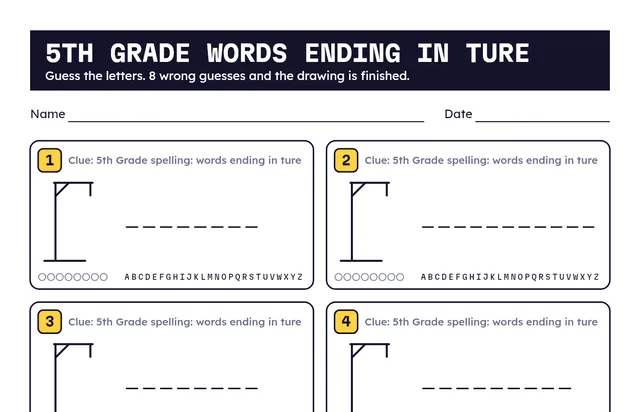 5th Grade Words Ending in Turefuture · picture · culture · nature
-
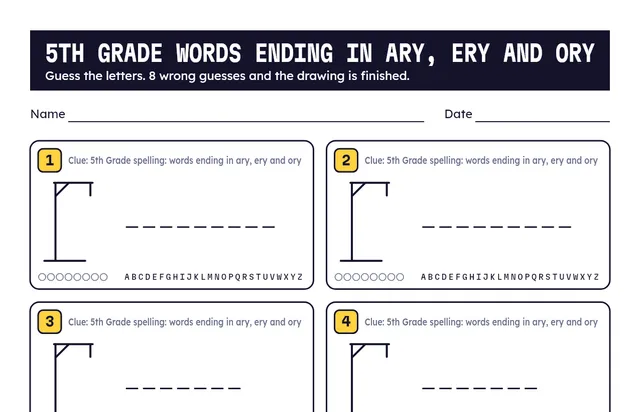 5th Grade Words Ending in Ary, Ery and Orysecretary · necessary · primary · library
What this year covers
There are two main strands. The first is roots: Latin Roots Port, Spect and Tract, Latin Roots Dict, Rupt and Struct, Greek Roots Graph, Phon and Tele, and Greek Roots Bio, Auto and Micro. Students learn what each root means and how it appears in different words. The second is suffixes and endings: Words Ending in Ance and Ence, Words Ending in Ant and Ent, Words Ending in Ity, Words Ending in Ive, Words Ending in Ture, and Words Ending in Ary, Ery and Ory.
The year is a move from sound to meaning. In earlier grades students are asked to hear a pattern; here they are asked to think about what a word is built from, and to use related words as a spelling aid, for example importance for important or difference for different. Many of these endings sound the same, so the reasoning matters.
A weekly routine that works
A simple routine is one root or ending per week. Monday: introduce the pattern and have students find the root or ending in ten words. Tuesday: hangman as a class, with the root revealed as a clue. Wednesday: print the worksheet and have students write the meaning of each root. Thursday: partner games, in which each player chooses a word and gives only the meaning as a clue. Friday: a short dictation and one sentence per root.
Keep a wall chart of roots and their meanings that grows through the year, and add a new word each time a student finds one in reading. Return to earlier roots every few weeks, because a root is only useful if students recognize it in unfamiliar words.