School subjects · hangman category
Books Hangman Words
Books hangman words for reading class and library visits: story elements, parts of a book, genres and figurative language, free to play or print.
Read the word list
This list teaches the language that students need to talk about reading. It starts with the parts of a book: cover, spine, index, glossary and chapter. It moves to story elements, including character, setting, plot, conflict and resolution. It then covers genres, from fantasy to biography, and finishes with literary devices such as simile, metaphor and alliteration. No actual book titles are used, only the vocabulary that appears in any reading curriculum.
Short words such as plot, page and poem are quick wins and help younger children feel successful. Longer words test older readers. Autobiography, personification and foreshadowing have many syllables, and thesaurus and encyclopedia hide letters that players rarely try first. The phrases, such as main character and point of view, are good for an English language arts lesson where students must explain each term after they solve it.
76 entries. Our solver needed 2.1 wrong guesses on average: 38 easy, 26 medium and 12 hard. The toughest is point of view (7 misses), the quickest illustrator (0).
- author Medium · 3
- illustrator Easy · 0
- character Easy · 1
- setting Easy · 1
- plot Hard · 6
- theme Medium · 3
- conflict Medium · 2
- resolution Easy · 0
- climax Medium · 2
- narrator Medium · 2
- dialogue Easy · 0
- chapter Easy · 1
- title Medium · 3
- cover Hard · 5
- spine Medium · 3
- page Hard · 6
- index Medium · 2
- glossary Medium · 2
- contents Easy · 0
- library Easy · 1
- librarian Easy · 1
- fiction Medium · 3
- nonfiction Easy · 1
- biography Easy · 1
- autobiography Easy · 1
- mystery Easy · 1
- fantasy Medium · 4
- poetry Easy · 1
- poem Hard · 6
- rhyme Hard · 6
- stanza Medium · 2
- verse Easy · 1
- genre Medium · 3
- summary Medium · 3
- sequel Medium · 2
- series Easy · 0
- novel Hard · 5
- publisher Easy · 1
- edition Easy · 1
- paperback Medium · 2
- hardcover Easy · 1
- bookmark Medium · 3
- bookshelf Easy · 1
- reader Easy · 0
- inference Easy · 0
- metaphor Easy · 1
- simile Easy · 1
- personification Easy · 0
- alliteration Easy · 0
- protagonist Easy · 0
- antagonist Easy · 1
- foreshadowing Easy · 0
- folktale Easy · 0
- fable Medium · 2
- legend Easy · 1
- dictionary Easy · 1
- thesaurus Easy · 0
- encyclopedia Easy · 0
- atlas Medium · 3
- magazine Easy · 1
- newspaper Easy · 0
- prologue Medium · 2
- epilogue Easy · 1
- main character Medium · 2
- point of view Hard · 7
- table of contents Hard · 6
- library card Hard · 5
- story map Hard · 7
- picture book Hard · 7
- chapter book Medium · 4
- rising action Medium · 2
- falling action Medium · 3
- book report Hard · 7
- first person Medium · 2
- read aloud Medium · 3
- bedtime story Easy · 1
Words worth a closer look
- libraryOften misspelled and mispronounced as libary, with the first r dropped. The word comes from the Latin liber, book, which is also the root of librarian.
- glossaryFrom the Greek glossa, tongue or language. The list of key terms at the back of a textbook is one that students often skip, so this is a good word to introduce it.
- stanzaA group of lines in a poem. It comes from an Italian word meaning room, which makes a handy image for a verse that holds its lines together.
- simileRelated to the Latin similis, like, and to the English word similar. It compares two things using like or as, and its final e is silent in English but pronounced in the original Latin.
- alliterationStarts with a double l and has a t that appears twice. It means repeating the opening sound across nearby words, as in a tongue twister.
- protagonistFrom the Greek protos, first, and agonistes, a competitor or actor. Teachers often pair it with antagonist, which uses the Greek anti, against.
- foreshadowingContains the word shadow, a handy memory trick for the spelling. It means hinting at what will come later in a story.
- indexFrom a Latin word for a pointer, and originally meant the forefinger. In a book it is the alphabetical list that points a reader to the right page.
Using this list in class
An English teacher can run a story elements review with character, setting, plot, conflict, theme and resolution as a single round, asking students to name each element from a book the class has just finished. Younger readers can start with cover, page, title, author and illustrator, matching each to the front of a picture book passed around the circle.
A school librarian can use library, librarian, fiction, nonfiction, biography, dictionary and atlas to teach where each shelf is, and the phrase library card to remind classes how borrowing works. For poetry month, play stanza, verse, rhyme, simile and metaphor. Parents can print a sheet to pair with bedtime reading, asking a child to find one example of each word.
Print a Books Hangman worksheet
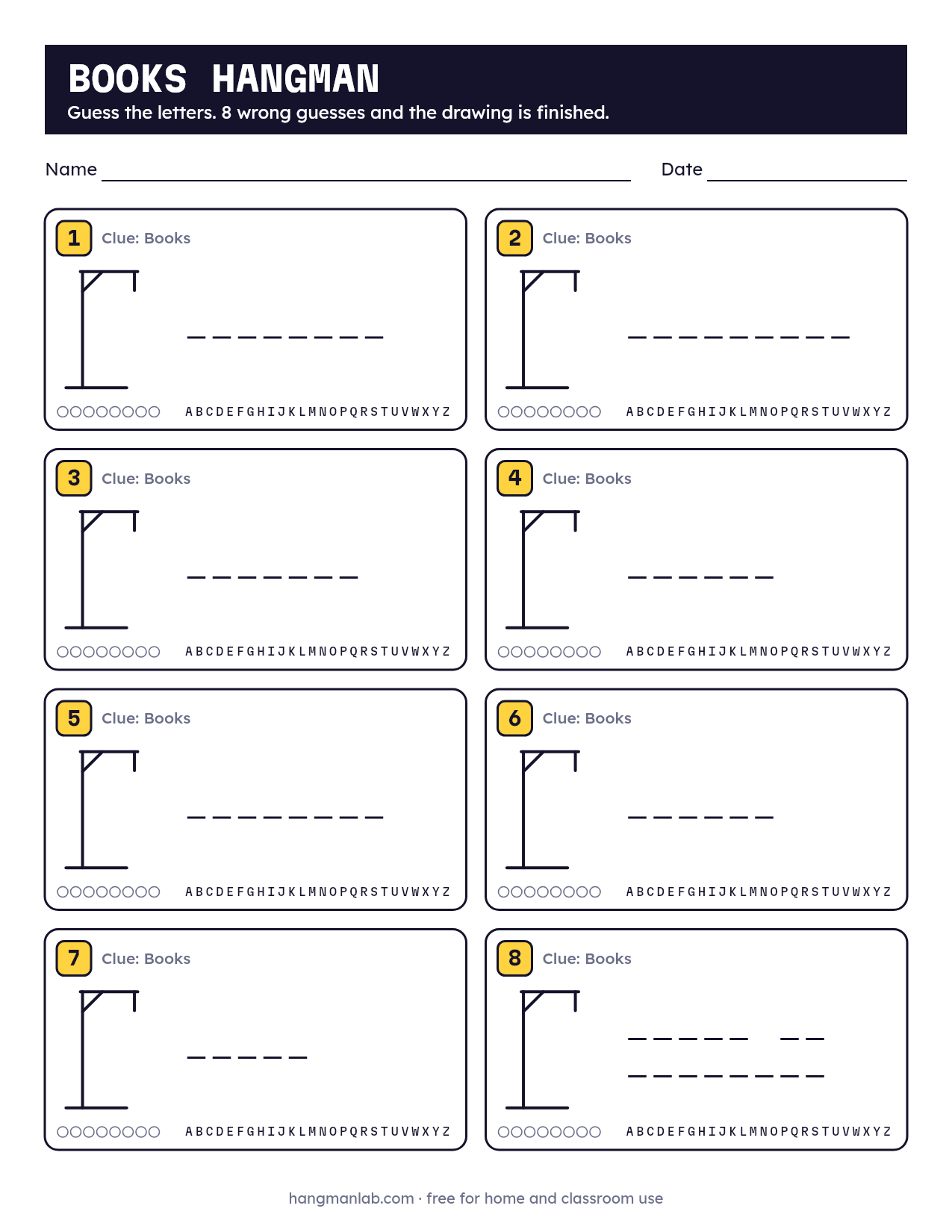
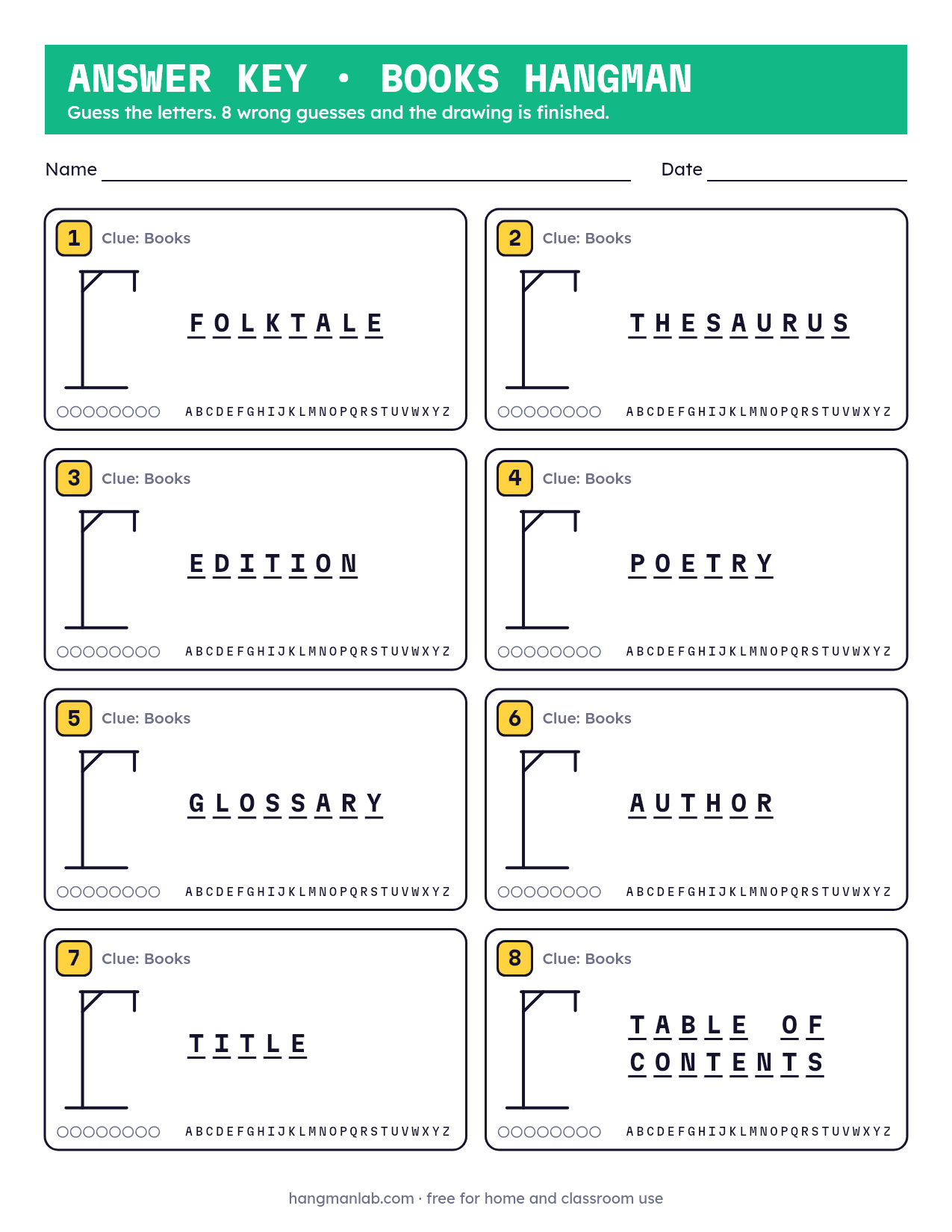
Eight puzzles on one US Letter page, with a clue, letter blanks, an empty frame to draw in, an alphabet strip to cross off and circles to count misses. Page two is the answer key.
Need another sheet?
Draw eight different words from this list, right here. Same layout, new answer key.
Keep going
- School Hangman WordsSchool hangman words from the classroom, hallway and playground: supplies, places, people and routines, for kindergarten through middle school.
- Music Hangman WordsMusic hangman words for the classroom: instruments, notation, tempo markings and orchestra vocabulary, with printable sheets for music teachers.
- Art Hangman WordsArt hangman words covering materials, techniques, the elements of art and principles of design, for art teachers and families to play or print.
- History Hangman WordsHangman words about history: documents, inventions, explorers and eras from the Pilgrims to the printing press. Play online or print with an answer key.
- Fairy Tales Hangman WordsFairy tale hangman words from classic Grimm, Andersen, Perrault and English folk tales: characters, places and objects, free to play or print.
- Science Hangman WordsScience hangman words drawn from elementary and middle school units: the scientific method, matter, energy, life science and earth science.