School subjects · hangman category
Chemistry Hangman Words
Chemistry hangman words: element names, lab equipment and reaction vocabulary for middle school and high school science classes, with printable sheets.
Read the word list
Chemistry mixes two kinds of vocabulary, and this list uses both. The first is the periodic table: element names such as hydrogen, sodium, calcium and xenon, which students meet again and again. The second is the language of the lab and of reactions: beaker, pipette, catalyst, precipitate, titration and solvent. Together they cover the first year of middle school science through the opening weeks of a high school course.
Element names make useful hangman answers because they vary so much. Iron, zinc and neon are short and give younger players a win. Magnesium, phosphorus and fluorine are long and use letters that are guessed late. Silver, copper and gold are everyday words that often start a game. The phrases, including periodic table and chemical reaction, sit well on a board when the class needs a group review of the core ideas.
74 entries. Our solver needed 2.5 wrong guesses on average: 27 easy, 36 medium and 11 hard. The toughest is lab coat (12 misses), the quickest element (0).
- element Easy · 0
- atom Medium · 2
- molecule Medium · 2
- compound Medium · 3
- mixture Easy · 1
- solution Medium · 2
- solvent Easy · 1
- solute Medium · 2
- acid Medium · 2
- base Medium · 3
- neutral Easy · 1
- proton Medium · 2
- neutron Medium · 2
- electron Easy · 1
- nucleus Medium · 2
- isotope Medium · 2
- periodic Easy · 0
- hydrogen Easy · 1
- helium Medium · 2
- lithium Medium · 3
- carbon Hard · 5
- nitrogen Medium · 2
- oxygen Hard · 6
- fluorine Easy · 1
- neon Medium · 2
- sodium Medium · 3
- magnesium Easy · 1
- aluminum Medium · 2
- silicon Easy · 1
- phosphorus Medium · 2
- sulfur Medium · 4
- chlorine Easy · 1
- argon Medium · 2
- potassium Medium · 2
- calcium Medium · 4
- iron Hard · 6
- copper Hard · 5
- zinc Hard · 9
- silver Hard · 5
- gold Hard · 10
- mercury Medium · 3
- iodine Easy · 0
- krypton Medium · 3
- xenon Medium · 3
- beaker Hard · 5
- flask Medium · 4
- pipette Medium · 2
- crucible Medium · 2
- catalyst Medium · 2
- reaction Easy · 0
- precipitate Easy · 0
- indicator Easy · 1
- litmus Medium · 4
- valence Easy · 0
- ionic Hard · 5
- covalent Easy · 1
- oxidation Easy · 1
- distillation Easy · 0
- filtration Easy · 1
- titration Easy · 1
- concentration Easy · 0
- periodic table Medium · 2
- noble gas Medium · 3
- chemical reaction Easy · 0
- atomic number Easy · 1
- atomic mass Easy · 1
- alkali metal Medium · 2
- safety goggles Medium · 3
- lab coat Hard · 12
- chemical bond Hard · 6
- boiling point Medium · 4
- melting point Easy · 1
- graduated cylinder Easy · 1
- test tube Medium · 4
Words worth a closer look
- sodiumIts symbol is Na, taken from the Latin natrium. That mismatch between the English name and the symbol is a common quiz question, and the same is true of potassium (K) and mercury (Hg).
- heliumNamed from the Greek helios, the sun, because it was first detected in the spectrum of sunlight before anyone found it on Earth.
- phosphorusFrom Greek words meaning light-bringer. Ten letters in which p, h, o and s each appear twice, so a correct guess fills several blanks at once.
- xenonFrom the Greek xenos, stranger. A word that starts with x is rare, and that x is almost never guessed early.
- aluminumThe US spelling. British English uses aluminium with an extra i, so teachers following a US curriculum should expect the shorter form.
- kryptonFrom the Greek kryptos, hidden, because it was difficult to find. It has only one vowel, o, so a player who opens with a, e and i will lose several guesses.
- precipitateIn chemistry it is the solid that forms when two solutions react. The word is also a verb in everyday English, which gives students a second meaning to learn.
- pipetteA small tube used to measure and move liquid. Two p's and two t's make it a spelling trap even for students who handle one regularly.
Using this list in class
Chemistry teachers can split the list in two for a vocabulary check. Use the element names for a periodic table unit, asking students to give the symbol after each solved word. Use the lab words, beaker, flask, pipette, crucible and graduated cylinder, at the start of the year so students learn the names before the first practical.
For a revision lesson on atoms, play proton, neutron, electron, nucleus and isotope, then add atomic number and atomic mass as phrases. A homeschool parent can print the sheet and ask a child to explain each answer in a sentence. Teachers can also use the compounds and acid and base words as an exit ticket on the last day of a unit.
Print a Chemistry Hangman worksheet
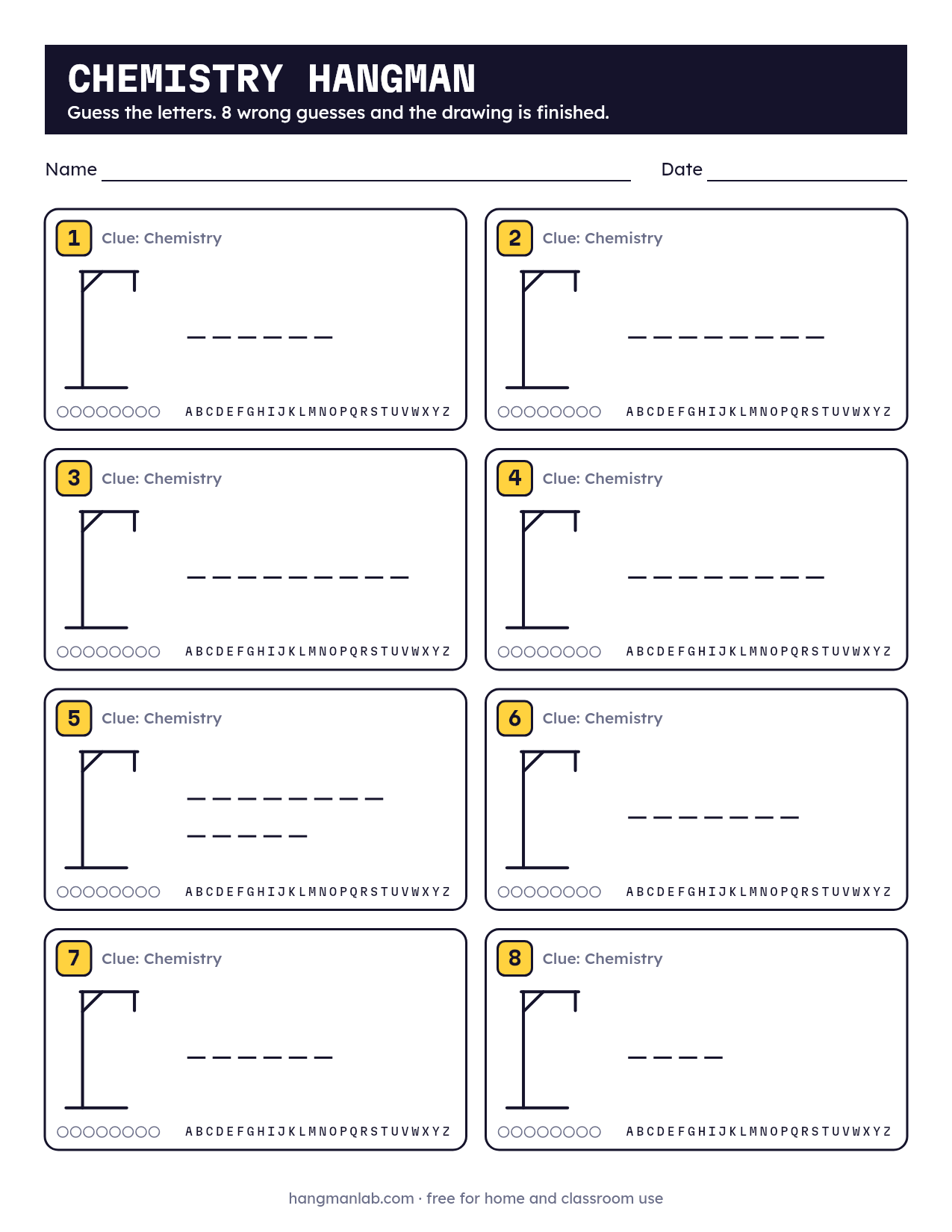
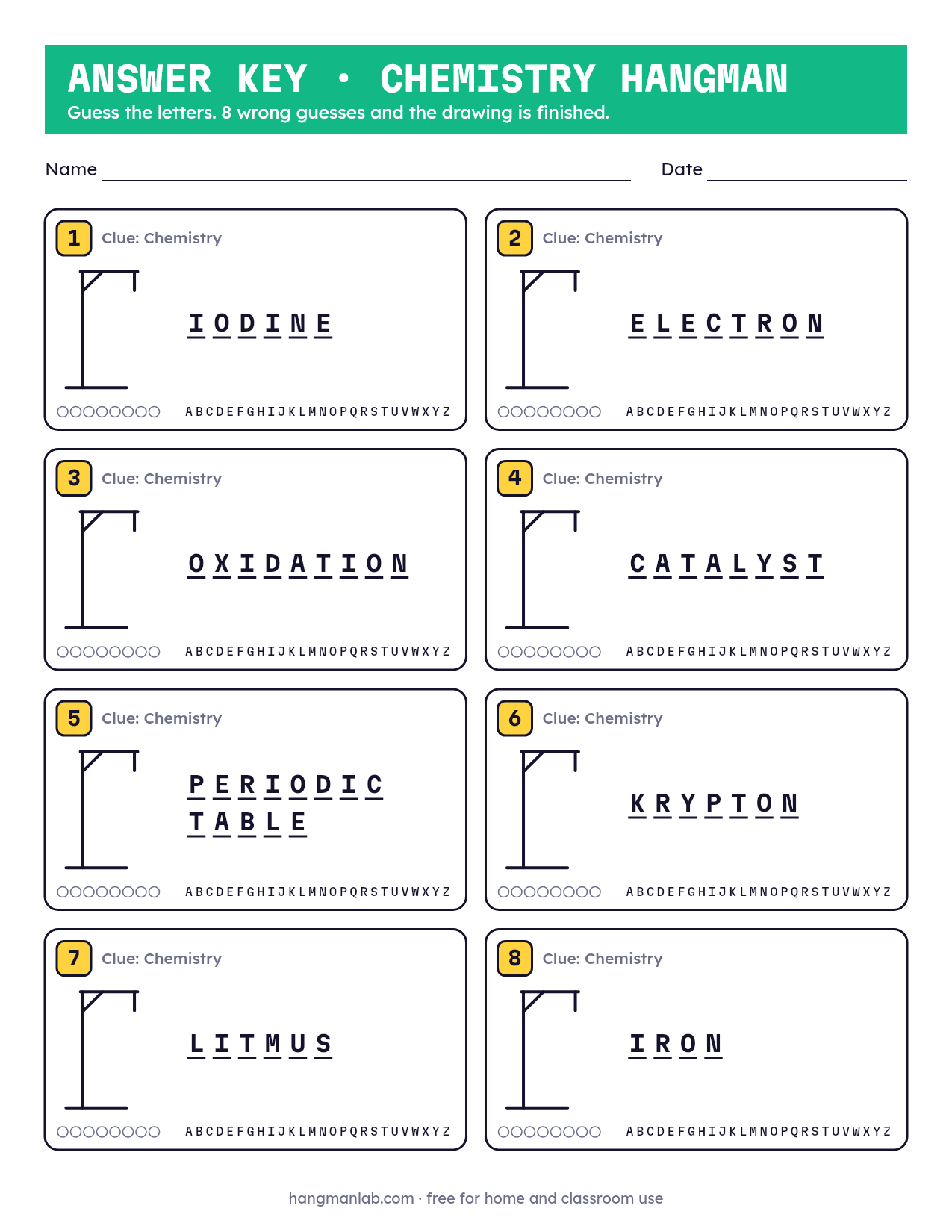
Eight puzzles on one US Letter page, with a clue, letter blanks, an empty frame to draw in, an alphabet strip to cross off and circles to count misses. Page two is the answer key.
Need another sheet?
Draw eight different words from this list, right here. Same layout, new answer key.
Keep going
- Science Hangman WordsScience hangman words drawn from elementary and middle school units: the scientific method, matter, energy, life science and earth science.
- Math Hangman WordsMath hangman words for elementary and middle school: fractions, geometry, operations and data, with a printable sheet and answer key for the classroom.
- Cooking Hangman WordsCooking hangman words for verbs, tools and measures, from whisk and simmer to colander and marinate. Play online or print with an answer key.
- Space Hangman WordsSpace hangman words covering planets, stars, orbits and astronomy. Play online with this list or print a sheet with an answer key for class.
- Human Body Hangman WordsHuman body hangman words covering bones, organs, muscles, senses and body systems, built for health and life science units in elementary and middle school.
- Music Hangman WordsMusic hangman words for the classroom: instruments, notation, tempo markings and orchestra vocabulary, with printable sheets for music teachers.