Sight words
High-Frequency Words
High-frequency words are the words that appear most often in written and spoken English. Knowing them well makes reading, writing and spelling faster, because a few hundred words account for a very large share of any page. This section offers five bands of 100 words each, from the most common words to number 500.
We built these lists ourselves. They are ranked using the open wordfreq corpus by Robyn Speer and colleagues (licensed CC BY-SA 4.0), which blends modern subtitles, books, Wikipedia, news and web text. We kept only real dictionary words and removed anything unsuitable for a family site. We did not copy Fry's list or any other published product.
That source matters. It reflects the way adults write and speak now, not the children's books of the 1930s that lie behind the Dolch lists. Our ranking is a better fit for spelling practice, for older readers and for English learners than for kindergarten, where Dolch is the better match. The two overlap a lot: 208 of our 500 words are on a Dolch list, and 94 of the top 100 are.
High-frequency words by rank
-
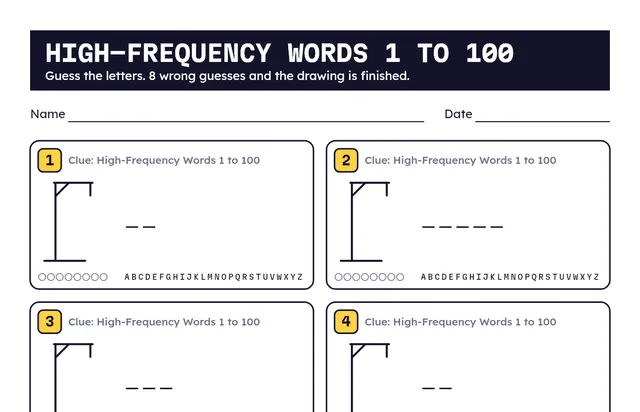 High-Frequency Words 1 to 100the · to · and · of
-
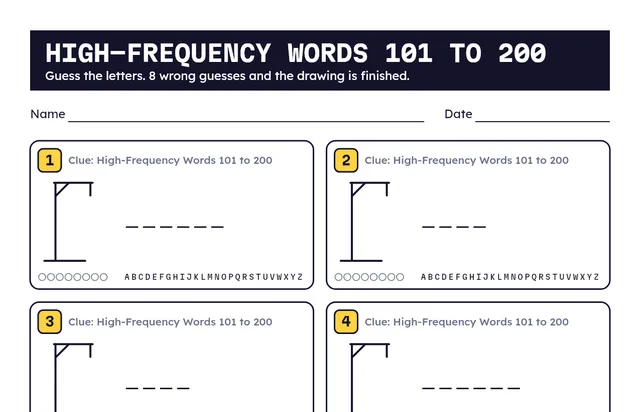 High-Frequency Words 101 to 200very · where · even · should
-
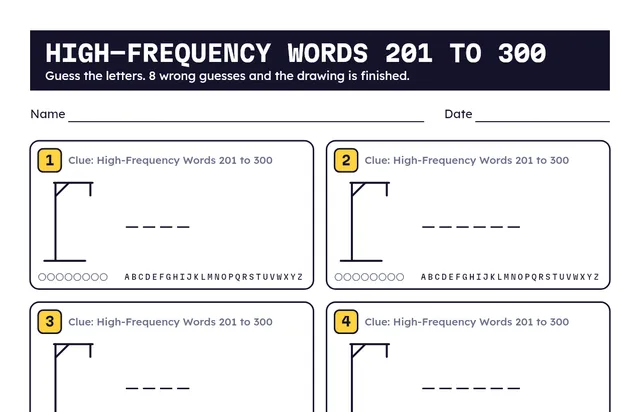 High-Frequency Words 201 to 300city · days · lot · name
-
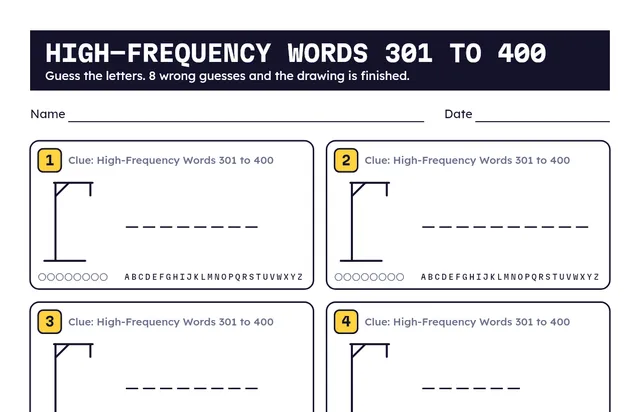 High-Frequency Words 301 to 400law · makes · together · whole
-
 High-Frequency Words 401 to 500human · members · months · move
Compare with
Teaching with these lists
Use the bands in order for students who need the basics: the first band is mostly small function words, and by the third and fourth bands the words are bigger and more varied. For an ESL class, the first 200 are a sensible first target, with the rest as extension.
Teach through phonics, not by repetition alone. Current reading research favors mapping the regular parts of a word to its sounds and marking only the irregular part, the heart of the word, for memory. Hangman fits: each guess is one letter, the finished word shows every letter in order, and students attend to the whole spelling.