Spelling words
8th Grade Spelling Words
Eighth grade spelling is about the hard cases. Students have met most of the common prefixes and suffixes, and the words they still misspell are the ones where the pattern cannot be heard or where the history of the word overrides the sound. The lists on this page gather those cases, and they treat them as questions of word origin: why is it ible and not able, why is it ph and not f, why is the p in psychology silent.
Each list has up to thirty words and is available as a hangman game and a printable worksheet with an answer key. The shorter lists, such as ceed, cede and sede, are short because the whole pattern fits in ten words. The difficulty scores next to the words show which are hardest to guess, and eighth graders enjoy ranking them against their own spelling.
8th Grade spelling lists
-
 8th Grade Words Ending in Ibleirresponsible · susceptible · tangible · plausible
-
 8th Grade Words Ending in Cious and Tiousmalicious · gracious · spacious · ferocious
-
 8th Grade Words Ending in Ientpatient · ancient · client · sufficient
-
 8th Grade PH Wordsphysical · philosophy · atmosphere · physics
-
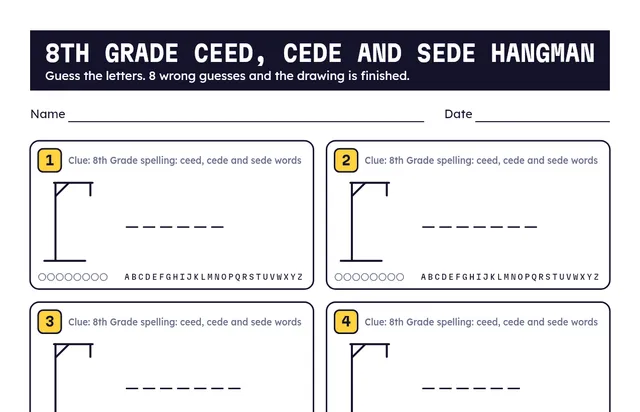 8th Grade Ceed, Cede and Sede Wordsexceed · proceed · succeed · precede
-
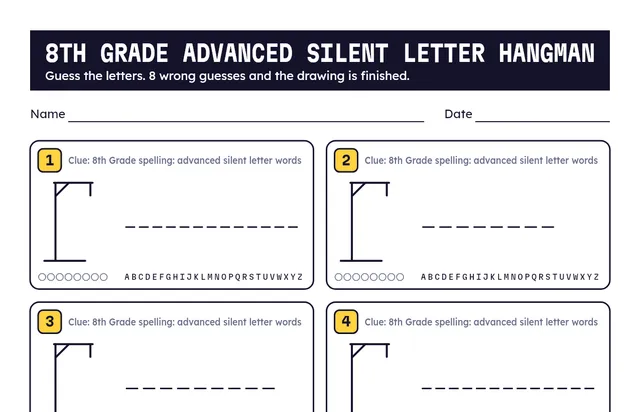 8th Grade Advanced Silent Letter Wordspsychological · psychic · pseudo · psychiatry
-
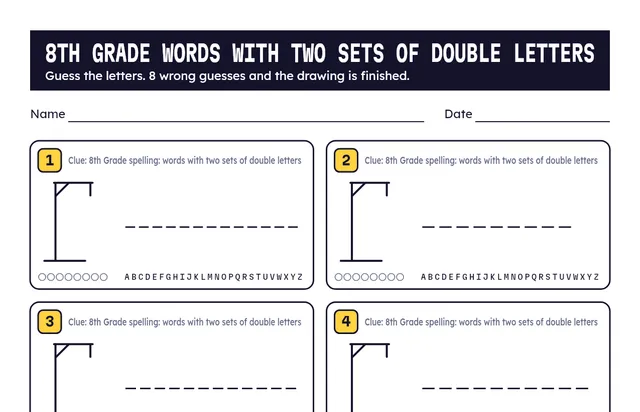 8th Grade Words With Two Sets of Double Letterscommittee · committed · officially · successfully
What this year covers
The lists fall into three groups. Look-alike endings: Words Ending in Ible, Words Ending in Cious and Tious, and Words Ending in Ient. Words shaped by Greek and Latin history: PH Words, Advanced Silent Letter Words and Ceed, Cede and Sede Words. Words that rely on careful chunking: Words With Two Sets of Double Letters.
Middle school word study at this level is largely about origins. Students use what they know about Greek roots, such as phon, graph and psych, to explain a silent letter or a ph, and what they know about Latin roots, such as cede, to see why exceed and precede are spelled differently. The explanation is part of the learning, and a student who can say why a word is spelled that way is far less likely to misspell it again.
A weekly routine that works
A weekly routine for eighth grade: on Monday, take ten words from one list and ask students to explain the spelling. On Tuesday, play hangman as a class. On Wednesday, print the worksheet and complete it independently. On Thursday, students write a paragraph using eight of the words. On Friday, take a dictation and mark errors by type (silent letter, ending, doubling) rather than by simply counting.
Tracking the type of error is more useful than counting them, because it shows which pattern to revisit. Return to the earlier lists every few weeks, since these are the words that students miss again unless they are reviewed.