Spelling words
6th Grade Spelling Words
Sixth grade spelling is about morphology: how words are built from prefixes, roots and suffixes. By now students read texts dense with academic vocabulary, and spelling instruction works best when it uses the structure of those words instead of treating each as a separate memory task. The lists here concentrate on the prefixes and suffixes that appear most in middle school reading, and they are designed to be taught as families.
Each list has up to thirty words, with the prefix or suffix at the front or end, and each can be played as hangman or printed as a worksheet with an answer key. The shorter lists, such as anti and super, are shorter because the number of common words that fit the pattern is small, not because the work is easier. The difficulty score next to each word helps you pick starting and finishing words.
6th Grade spelling lists
-
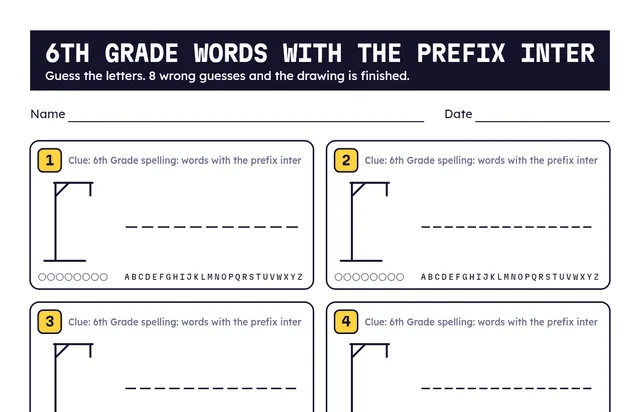 6th Grade Words With the Prefix Interinternational · internet · interview · interaction
-
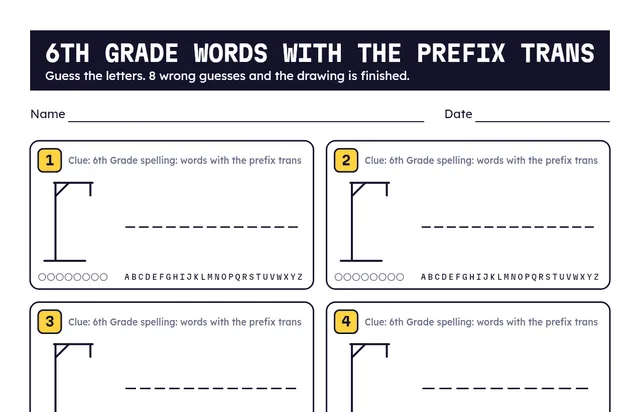 6th Grade Words With the Prefix Transtransfer · transition · translation · transaction
-
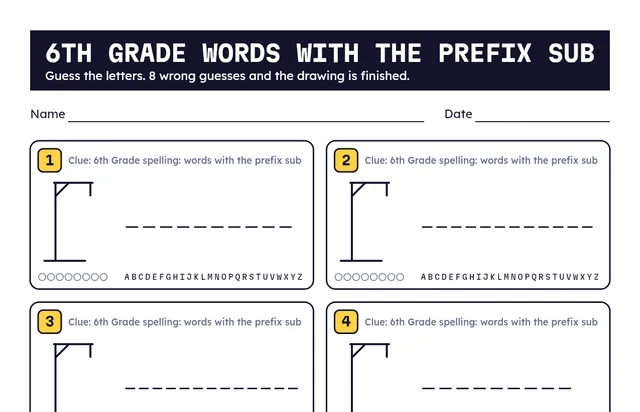 6th Grade Words With the Prefix Subsubject · substantial · submit · subsequently
-
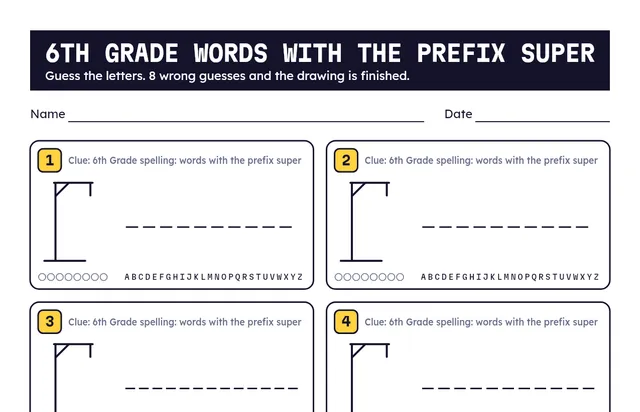 6th Grade Words With the Prefix Supersuperintendent · supervisor · supervision · supernatural
-
 6th Grade Words With the Prefix Antiantibiotic · antibody · antitrust · antidote
-
 6th Grade Words Ending in Ologytechnology · psychology · ideology · theology
-
 6th Grade Words Ending in Ismcriticism · tourism · mechanism · journalism
What this year covers
The prefix strand covers Words With the Prefix Inter, Words With the Prefix Trans, Words With the Prefix Sub, Words With the Prefix Super and Words With the Prefix Anti. These come from Latin except for anti, which is Greek, and they introduce the idea that English draws on several ancient languages. The suffix strand covers Words Ending in Ology and Words Ending in Ism, two endings that name fields of study and beliefs or practices.
The aim is for students to look at an unfamiliar word and ask what the parts mean. This also changes how they correct their own writing: instead of guessing a letter, they check whether the prefix and base were joined correctly. The root lists from fifth grade pair well with this year's work, and the lists for seventh grade extend the suffix strand.
A weekly routine that works
A workable routine: choose one prefix or suffix per week. On Monday, show the meaning and ask students to predict meanings of five words. On Tuesday, play hangman with the prefix given. On Wednesday, print the worksheet and ask students to separate each word into prefix, base and ending. On Thursday, have students build new words by adding the prefix to bases of their own choosing and check them in a dictionary. On Friday, dictate ten words.
Because sixth graders can handle abstract reasoning, add an explanation task each week: a sentence that explains why a word is spelled the way it is. Keep a personal list of words that were missed and review it at the start of each week.